


Malaysia traffic rules for tourists in 2026 follow a straightforward framework: drive on the left, observe posted speed limits, wear your seatbelt, and keep your documents accessible. The biggest adjustment for most visitors is left-hand traffic — steering wheel is on the right side, and you overtake on the right lane. Malaysia's road network is excellent, with well-marked highways and clear signage in English. However, enforcement is strict, speed cameras are widespread, and the 2026 fine system has changed how traffic summons are calculated. This guide covers everything you need to know before picking up your rental car.
From operating 72 rental cars in Kuala Lumpur daily, we brief every customer before departure: the most common violations tourists face are speeding (underestimating how quickly 110 km/h becomes 90 km/h on an exit ramp), emergency lane misuse (pulling into the emergency lane when traffic slows), and missing the seatbelt reminder for rear passengers. Each of these carries a minimum RM300 fine under Malaysia's 2026 summons system. This guide gives you the exact rules, amounts, and practical tips our team shares at every rental handover.
Malaysia's Road Rules Explained for First-Time Visitors
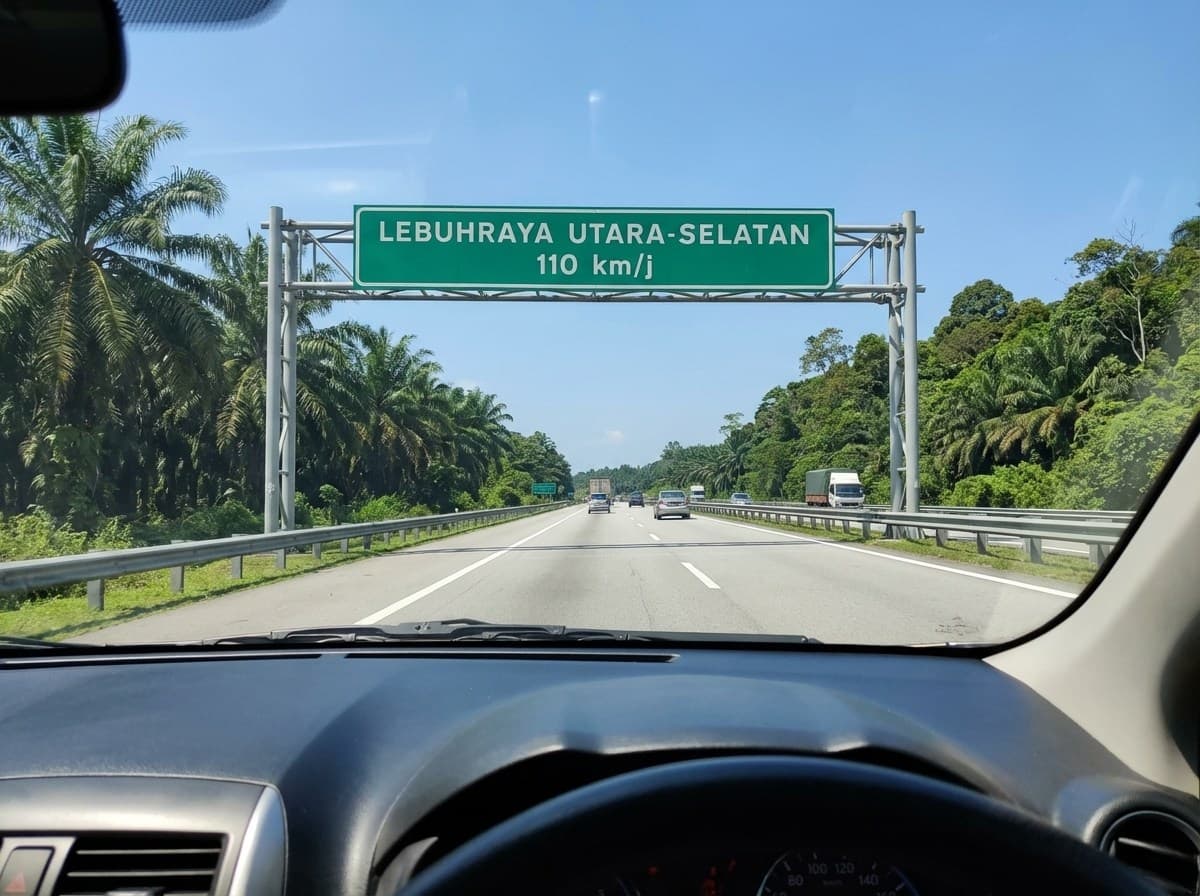
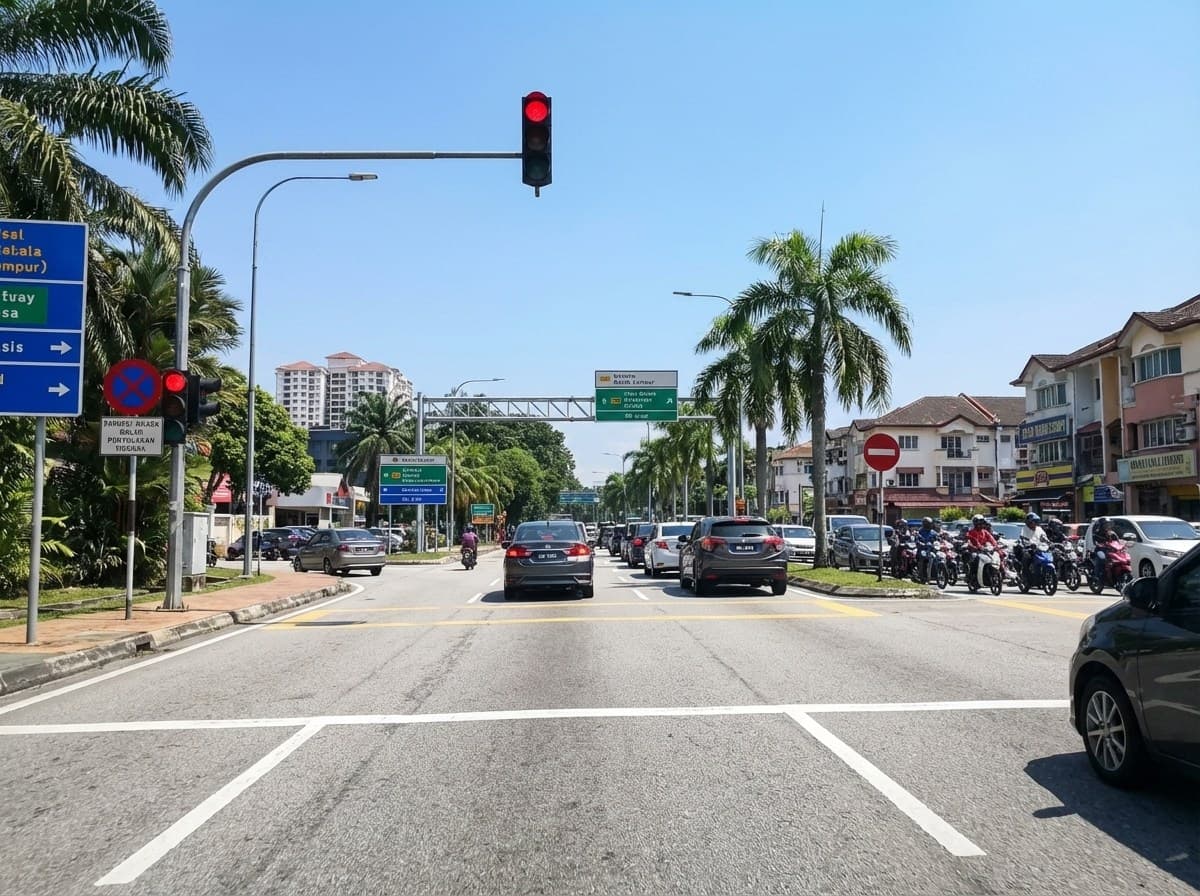
Malaysia's road system operates on the British left-hand traffic model — a legacy of colonial-era infrastructure that remains today. For visitors from the United States, most of Europe, China, and the Middle East, the transition to left-hand driving requires conscious attention, especially at intersections, roundabouts, and highway on-ramps. The steering wheel is positioned on the right side of the vehicle, and the left lane is the slow lane (not the fast lane as in continental Europe and North America). Overtaking happens on the right. At intersections without traffic lights, yield to the right. In roundabouts, vehicles already in the roundabout have priority — you give way before entering. These fundamentals become second nature within a day or two of driving, but remain the source of most first-day confusion for tourist drivers.
Malaysia's expressway network — anchored by the 772-kilometre PLUS North-South Expressway — is genuinely world-class. Lanes are wide, signage is bilingual (Malay and English), and service stations appear every 50–80 kilometres with food, fuel, prayer rooms, and rest facilities. Urban roads in Kuala Lumpur are well-maintained but congested during peak hours (7–9am and 5–8pm on weekdays). The Klang Valley's highway interchanges can be complex, with overlapping routes serving KLIA, the city centre, Petaling Jaya, and Subang simultaneously. Before any road trip from KL, use Google Maps or Waze with real-time traffic enabled — these apps are used by every Malaysian driver and accurately reflect current conditions, toll charges, and estimated journey times.
Seven Traffic Rules Every Tourist Must Know
Drive on the Left, Overtake on the Right : Malaysia follows British left-hand traffic. Keep left unless overtaking. The rightmost lane of a three-lane highway is the fast lane — do not cruise in it. Return to the centre or left lane after overtaking. Cruising in the right lane ("hogging") is technically an offence and draws horn signals from local drivers.
Seatbelts Are Mandatory for All Passengers — Including Rear Seats : Every person in the vehicle must wear a seatbelt — front and rear. The fine for not wearing a seatbelt is RM300 per person. Police and JPJ officers conduct routine checks on highways and at checkpoints. Make it a habit to ensure all passengers buckle up before the car moves. As the driver, you are responsible for passengers under 14 years old.
Never Use a Mobile Phone While Driving : Using a handheld mobile phone while driving is a non-compoundable offence in Malaysia — meaning it goes directly to court rather than being settled with a compound fine. Conviction carries fines up to RM2,000 and potential license suspension. Use a car mount for navigation, connect via Bluetooth for calls, or pull over safely before using your phone. This rule is actively enforced via patrol cars and AES camera footage.
The Emergency Lane Is Only for Emergencies : Malaysia's highways have a dedicated emergency lane (leftmost shoulder lane) for breakdowns, ambulances, and fire engines only. During traffic slowdowns, many drivers are tempted to use the emergency lane to bypass the jam. This is illegal and carries a fine of RM300 to RM2,000. Emergency lane misuse is one of the most actively enforced violations on Malaysian highways, with dedicated JPJ enforcement vehicles and cameras monitoring it.
Speed Cameras Are Everywhere — Know the Limits : Malaysia's Automated Enforcement System (AES) deploys fixed and mobile speed cameras on highways and urban roads. Camera locations are not publicly listed. The standard penalty for speeding is up to RM300, plus demerit points under the KEJARA system. Highway speed limit is 110 km/h; reduce to 90 km/h on federal and state roads and wherever posted. In built-up areas, the default is 50 km/h unless otherwise signed. School zones and hospital areas may have lower posted limits.
Keep Your Documents in the Glove Box : Always carry: your valid foreign driving licence (or IDP if your licence is not in English), your rental agreement, your passport, and your car insurance documentation. At police checkpoints (common during public holidays and festive periods), you will be asked to present your licence and, sometimes, the rental agreement. Keep documents in an accessible location — digging through bags at a checkpoint creates delays and unnecessary attention.
Understand Malaysia's 2026 Tiered Fine System : Effective January 2026, Malaysia standardised its traffic summons into a tiered payment structure: pay within 15 days for the minimum amount, or the fine increases at 30 days and again at 60 days. Category 2 offences (red light, illegal U-turn) start at RM150, rising to RM300 unpaid after 60 days. This system also eliminated the old blanket discount campaigns, meaning full enforcement applies year-round.
Malaysia Speed Limits by Road Type (2026)
| Road Type | Speed Limit | Notes |
|---|---|---|
| Expressways (highway) | 110 km/h | Max limit on PLUS North-South Expressway and major urban expressways (LDP, KESAS, MEX, NPE) |
| Mountainous / crosswind sections | 80–90 km/h | Posted on signs; lower limits apply in Cameron Highlands, Genting approaches, and east-coast mountain routes |
| Federal roads (trunk roads) | 90 km/h | Reduced to 80 km/h during festive seasons (Hari Raya, CNY, Deepavali) |
| State roads | 90 km/h | May be lower if posted; festive-season reduction applies |
| Urban / built-up areas | 50 km/h | KL city roads, Petaling Jaya, Subang, Puchong default |
| Town centres (federal/state road) | 60 km/h | Within town boundaries on federal and state road classifications |
| School zones (when active) | 30–40 km/h | Posted; enforced during school hours, often camera-monitored |
2026 Traffic Fine Amounts in Malaysia
Effective 1 January 2026, Malaysia's JPJ and PDRM unified their traffic summons under a standardised tiered system. Every compoundable offence now has a set fine amount that increases the longer you delay payment. There are no more blanket discount campaigns — full enforcement applies year-round. Non-compoundable offences (mobile phone use, driving without a valid licence, no insurance) bypass the fine system entirely and are taken directly to court, where conviction carries higher penalties.
| Offence | Pay within 15 days | Pay day 16–30 | Pay day 31–60 | Notes |
|---|---|---|---|---|
| Running a red light | RM150 | RM200 | RM300 | Category 2; also earns demerit points under KEJARA |
| Illegal U-turn | RM150 | RM200 | RM300 | Category 2 |
| Cutting traffic / dangerous lane change | RM150 | RM200 | RM300 | Category 2 |
| Not wearing seatbelt (per person) | RM300 | RM300 | RM300 | Fixed fine; applies to driver and all passengers |
| Emergency lane misuse | RM300 | RM300 | RM2,000 | Escalates significantly on highways; vehicle may be towed |
| Speeding (up to 40 km/h over limit) | Up to RM300 | Up to RM300 | Up to RM300 | Exact amount varies; AES cameras issue summons automatically |
| Speeding (over 40 km/h above limit) | RM300 | RM300 | RM300 | No early-payment discount for this category |
| Vehicle condition offence (e.g. expired road tax) | RM100 | RM150 | RM250 | Category 3 |
| P-sticker / licence violations | RM70 | RM120 | RM150 | Category 4; does not apply to tourists |
| Drunk driving (BAC > 0.08%) — first offence | RM300 minimum + up to 3 months jail | — | — | Non-compoundable above RM300; court action likely |
| Drunk driving — second offence | RM2,000–6,000 + up to 1 year jail | — | — | Court conviction mandatory |
| Mobile phone use while driving | Court summons | — | — | Non-compoundable; fine up to RM2,000 + possible suspension |
AES Speed Cameras and the KEJARA Demerit System
Malaysia's Automated Enforcement System (AES) uses fixed gantry cameras and mobile radar units to monitor speeds on highways and urban roads. Camera locations are not published, and they are active 24/7. When a vehicle exceeds the speed limit, the system photographs the licence plate and issues a summons by post to the registered owner — in the case of a rental car, this summons is forwarded to the rental company, which then charges the amount to your deposit or sends a separate invoice. Most reputable rental companies inform customers of this process at pickup. If you receive an AES summons notice after returning home, the rental company is legally obligated to share your contact details with JPJ, and the fine must be settled before your next entry into Malaysia. The KEJARA demerit system assigns points for traffic violations: accumulate 18 points in 12 months and your licence is suspended. For tourists on short-term visits, KEJARA points are less practically relevant than the immediate fine, but serious violations (drunk driving, no insurance) trigger immediate action regardless of visitor status.
What to Do at a Malaysia Police Checkpoint (PDRM Roadblock)
Police roadblocks (PDRM checkpoints) are common in Malaysia, particularly during public holidays, festive seasons (Hari Raya, Chinese New Year, Deepavali), and in areas near major events. For tourists, encountering a checkpoint for the first time can feel intimidating — it should not be. Checkpoints are routine safety checks for driving licences, alcohol, and vehicle documentation. As you approach, reduce speed, turn off your car radio, and roll down your window. When the officer signals you to stop, come to a complete stop, turn on your hazard lights, and wait. The officer will ask for your driving licence (have your IDP and original licence ready, or your foreign licence if it is in English), and may ask to see your vehicle registration and insurance documents. Speak calmly, answer questions directly, and do not make sudden movements. The interaction typically takes under two minutes. If the officer issues a fine slip (saman), accept it politely — payment can be made online via the JPJ e-Servis portal or at any POS Malaysia office. Never attempt to bribe an officer; this is illegal and carries severe penalties.
Roundabout Rules in Malaysia
Malaysia uses rotary roundabouts extensively, particularly in older Kuala Lumpur suburbs and secondary towns. The key rule: vehicles already inside the roundabout have right of way. You must yield before entering, regardless of which lane you are in. Signal your intended exit before you leave — left signal when you are about to exit, right signal or no signal when continuing around. Multi-lane roundabouts require lane discipline: use the left (outer) lane for the first or second exit, the inner lane for more than two exits. Modern roundabouts on major highways and expressway entry/exit points are typically well-signed with overhead lane guidance. If you miss your exit, complete the circuit and take it on the next pass — do not reverse or stop in the roundabout.
Malaysia Driving Documents Required at a Checkpoint
Keep these four documents accessible at all times in your rental car: (1) Your valid foreign driving licence in English — if your licence is not in English (e.g., Chinese, Arabic, Thai, Korean), you need an International Driving Permit (IDP) issued in your home country. (2) If you have an IDP, carry the original foreign licence alongside it — the IDP is not valid without the accompanying original. (3) Your rental agreement from MJ Adventure Travel or your rental company — this confirms the vehicle is legally in your possession and not stolen. (4) Your passport — officers occasionally ask for identity confirmation at checkpoints. Store these documents in the glove box, not in a bag in the boot. ASEAN citizens (Thailand, Singapore, Indonesia, Philippines, Vietnam, Brunei, Cambodia, Myanmar, Laos) may drive in Malaysia on their national licence without an IDP for tourism visits.
Driving Safety Tips Specific to Malaysian Roads
Watch for Motorcycles at All Times : Malaysia has one of the highest motorcycle densities in the world. Motorcycles filter between lanes at traffic lights, travel in the leftmost lane and shoulder at low speeds, and split lanes at speed on highways. Always check your left mirror before turning left and watch for motorcycles between your car and the kerb when opening doors. Most road incidents involving tourists in Malaysia involve failing to see a motorcycle.
Use Waze — Not Just GPS : Waze is the dominant navigation app in Malaysia, used by millions of local drivers. Unlike static GPS, Waze shows real-time police checkpoints, AES camera locations, road incidents, and flood alerts. Download it before your trip and use it even on routes you think you know. The app is particularly useful on the KL–Penang highway and during festive season travel when diversions and closures change normal routes.
Heavy Rain Reduces Visibility to Near-Zero : Malaysia's tropical climate produces sudden, intense rainstorms — particularly between 3–6pm in the Klang Valley. Rainfall can reduce highway visibility to 30–50 metres within seconds. When caught in heavy rain, slow down to 60–70 km/h on highways, turn on headlights (not hazard lights — these confuse lane-changing decisions), and maintain at least 4 seconds following distance. If visibility drops dangerously, pull into the next highway rest area and wait. Driving in flash-flood conditions is extremely dangerous.
Parking Violations Are Actively Fined in KL : Kuala Lumpur city centre parking enforcement is strict. DBKL (Kuala Lumpur City Hall) wardens fine and clamp illegally parked vehicles with efficiency. Double parking — common in older commercial areas — is technically illegal but widely practiced. Do not double-park when driving a rental car; clamping fees run RM100–150 and require physical attendance at a DBKL office to release. Use designated paid carparks (Bangsar, KLCC, Pavilion all have multi-storey facilities) or your hotel's valet service in the city centre.
Do Not Drive Tired on Long Highway Trips : Malaysia's highway fatigue rate is high, particularly on the PLUS North-South Expressway during festive season exodus. Mandatory rest stops every 2 hours are posted on highway signage. PLUS service areas (R&R — Rest and Recreation) are modern, well-lit, and serve food around the clock. If you feel drowsy, pull into the next R&R. Fatigue is the primary cause of single-vehicle accidents on Malaysian highways. Do not rely on energy drinks or windows-down driving — they are temporary measures, not substitutes for rest.
Every customer who picks up a rental car from us gets the same briefing: left side, seatbelt, no phone, know your speed. These four rules eliminate 90% of tourist road incidents in Malaysia.
Drive Confidently, Drive Legally
Malaysia's traffic rules are straightforward once you understand the fundamentals — left-hand driving, clear speed limits by road type, and a 2026 enforcement system that applies consistently year-round. The most critical points: seatbelt for every passenger (RM300 fine per person), no mobile phone while driving (court summons), respect the emergency lane (RM300–RM2,000), and observe posted speed limits on each road type (110 km/h highway, 90 km/h state/federal roads, 50 km/h urban).
The KEJARA demerit system means serious violations affect your driving record, but for most short-term tourist rentals, this is less of a concern than the immediate fine and potential vehicle impoundment for serious offences. Keep your documents accessible, drive in the left lane unless overtaking, and use Waze or Google Maps for real-time speed limit reminders — both apps display current speed limits and camera alerts on major roads.
MJ Adventure Travel's fleet of 72 cars serves tourists across Kuala Lumpur daily. Our team briefs every customer on these rules before departure. If you have questions about specific routes, checkpoints, or road conditions, ask at pickup — our staff drive these roads every day and know exactly what to expect.
Can I drive in Malaysia with my foreign driving licence?
Yes. If your foreign driving licence is in English, you can drive in Malaysia without an International Driving Permit (IDP). Licences not in English (e.g., Chinese, Arabic, Thai, Korean) require an IDP issued in your home country alongside the original licence. ASEAN citizens (Singapore, Thailand, Indonesia, Philippines, Vietnam, Brunei) can drive on their national licence without an IDP for tourism visits.
What is the speed limit on Malaysian highways?
The default speed limit on Malaysian expressways (including PLUS North-South Expressway, LDP, KESAS, MEX) is 110 km/h. On federal and state trunk roads, the limit is 90 km/h (reduced to 80 km/h during festive seasons). In urban and built-up areas, the default is 50 km/h. Posted signs always override the default — watch for lower limits on mountain approaches, near schools, and at road works.
What happens if I get a speeding fine (AES camera) in a rental car?
The AES system photographs your rental car's licence plate and issues a summons to the registered owner (your rental company). The rental company forwards the summons amount to you via your deposit or a post-return invoice. MJ Adventure Travel's rental agreement covers this process — you are responsible for all traffic fines incurred during your rental period. Unpaid AES summons must be settled before your next entry into Malaysia.
Is it legal to use the emergency lane in heavy traffic?
No. The emergency lane on Malaysian highways is strictly reserved for breakdowns, ambulances, and fire engines. Using the emergency lane during traffic congestion is illegal and carries fines of RM300 to RM2,000. JPJ enforcement vehicles actively patrol highways for emergency lane misuse, particularly during festive season. Never pull into the emergency lane to bypass traffic, even if you see other drivers doing so.
Do Malaysia traffic fines apply to tourist rental cars?
Yes. All Malaysian traffic laws and fines apply equally to tourist drivers and rental vehicles. Speeding, seatbelt, emergency lane, red light, and all other violations are enforceable regardless of nationality. Fines issued to rental cars are forwarded to the rental company, which charges the amount to you as outlined in your rental agreement.
What documents do I need at a police checkpoint in Malaysia?
You need your valid foreign driving licence (in English, or IDP + original licence), your rental agreement, and your passport. Keep these in the glove box for easy access. Do not keep them in your luggage in the boot. At a checkpoint, come to a full stop, roll down your window, and wait for the officer to request documents. The interaction is routine and typically takes under two minutes.
Official sources
Panduan berkaitan
- Dikategorikan dalam:Driving essentials, Travel planning
- Kemas Kini Terakhir:2026-04-10